

Last week, Josh Kushner announced a new fundraise of $2B on a $12B valuation for Thrive Holdings. Josh and Bob Iger also launched a bid to buy the Lakers for $12 billion dollars. Kushner is also an investor in OpenAI, Anthropic and a host of AI labs. What was the investment approach in order for him to do this?
It’s not talent or connections - it’s fund structure. Traditional venture funds run on a 10 year clock - raise, deploy, hold, and eventually sell. A permanent capital vehicle removes that clock entirely. There’s no LP waiting on a distribution date, no fund life forcing a sale into a bad market.
And with Thrive, there are three investment vehicles for each of these investments, there’s Thrive Eternal (concentrated long-hold PCV), Thrive Holdings (AI roll-up PCV), and Thrive Capital (the venture fund PCV).
The G-Wagon of Capital is the Permanent Capital Vehicle
The G-wagon was invented in 1972, short for Geländewagen or "cross-country vehicle". It was used mostly as an utilitarian workhouse but nowadays in 2026, it confers luxury status. Driving it down 280 and exiting Sand Hill road feels like a warlord exerting control over vast sums of territory. Looking to the right and seeing the fog trapped over the Santa Cruz mountains, the natural geography repeating ad infinitum, it evokes the same feeling of the permanent capital vehicle with no expiration date and infinitely compounding. GPs have full control over the fund and are able to decide what to do and when to do it.
What’s great about the permanent capital vehicle is it never expires. Instead of 10 year traditional windows where LPs pocket their returns and GPs are forced to sell their stakes, the shares can compound forever in an evergreen fund. Sequoia’s running the same playbook too. In 2021, Sequoia restructured out of the 10 year fund and into an evergreen fund, “The Sequoia Capital Fund”. The ten year stakes in companies like Airbnb and Doordash are still part of their holdings today. Likewise, the G-wagon silhouette is timeless. 54 years later, it still has the same properties and features as when it came out.
Let’s take a look at the beauty of the evergreen fund.
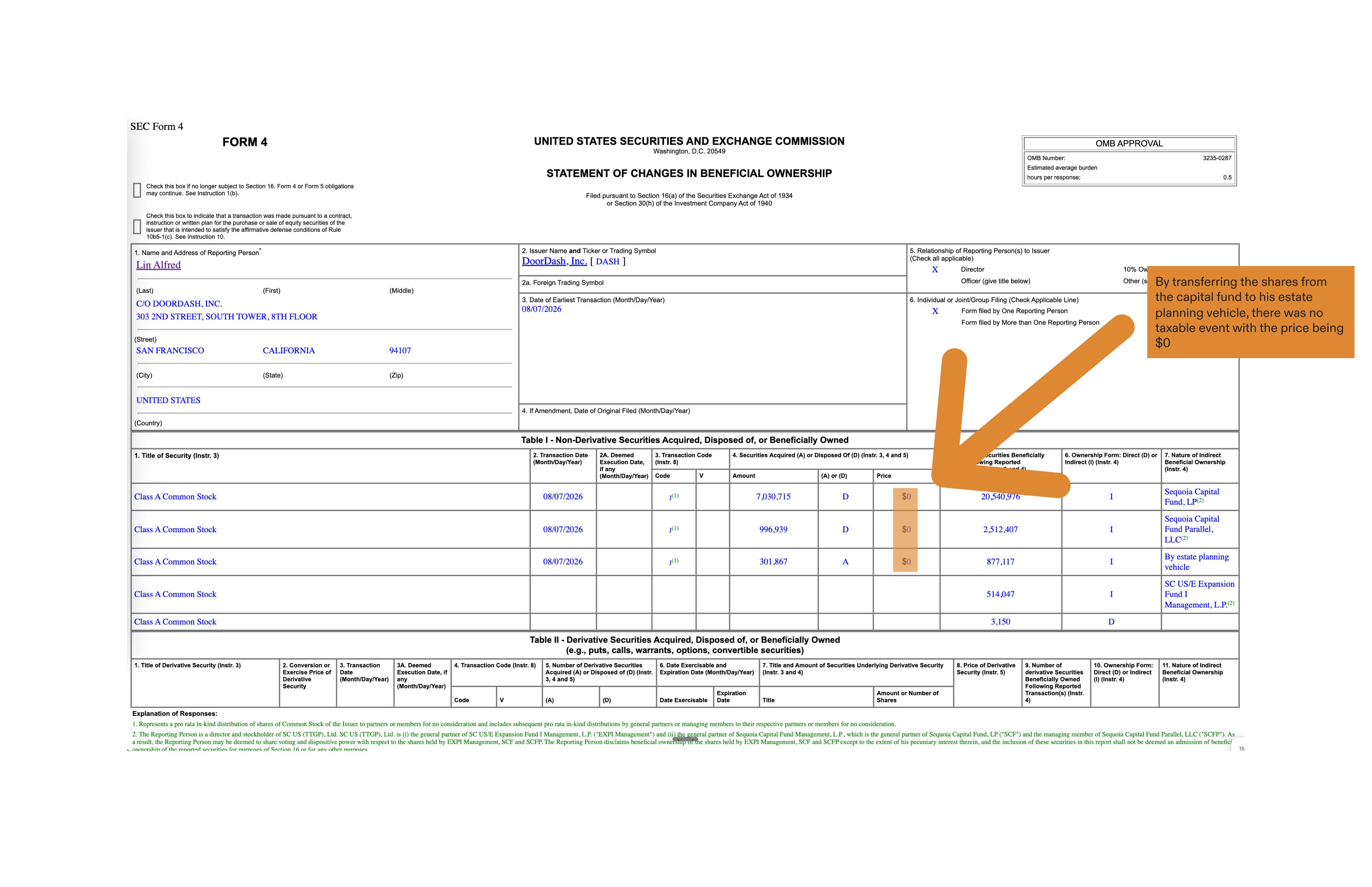
On August 7th, 2026, Alfred Lin submitted his Form 4 disclosing his change in beneficial ownership of Doordash Class A Common Stock.
Some technical details for understanding this form:
The Form 4 is the “Statement of Changes in Beneficial Ownership” which is required under the "Section 16(a) of the Securities Exchange Act of 1934, for certain “insiders” of a public company to report every time their ownership of that company’s stock changes
Once a reportable transaction happens, there’s a 2-day window for the insider to file.
Code J means that this type of transaction is category “other”. There are plenty of other transactions that could be filed such as P for purchases of stock, S for sales of stock, G for gifts of stock, and A to report grants of equity awards. Full list of transactions here.
The $0 transfer shows the versatility of the permanent capital fund controlling the timing and form of the distribution.
The beauty of the evergreen structure of the fund with no fund expiration means that Alfred Lin is able to do this distribution at any time. In this case, at the fund entity level, the two funds, “Sequoia Capital Fund, LP” and “Sequoia Capital Fund Parallel, LLC” distributed parts of this public stock position to Alfred’s personal estate structure.
In addition, the fund is able to have internal reallocation instead of open-market liquidation aligning long-term incentives and allowing more capital to compound over time.
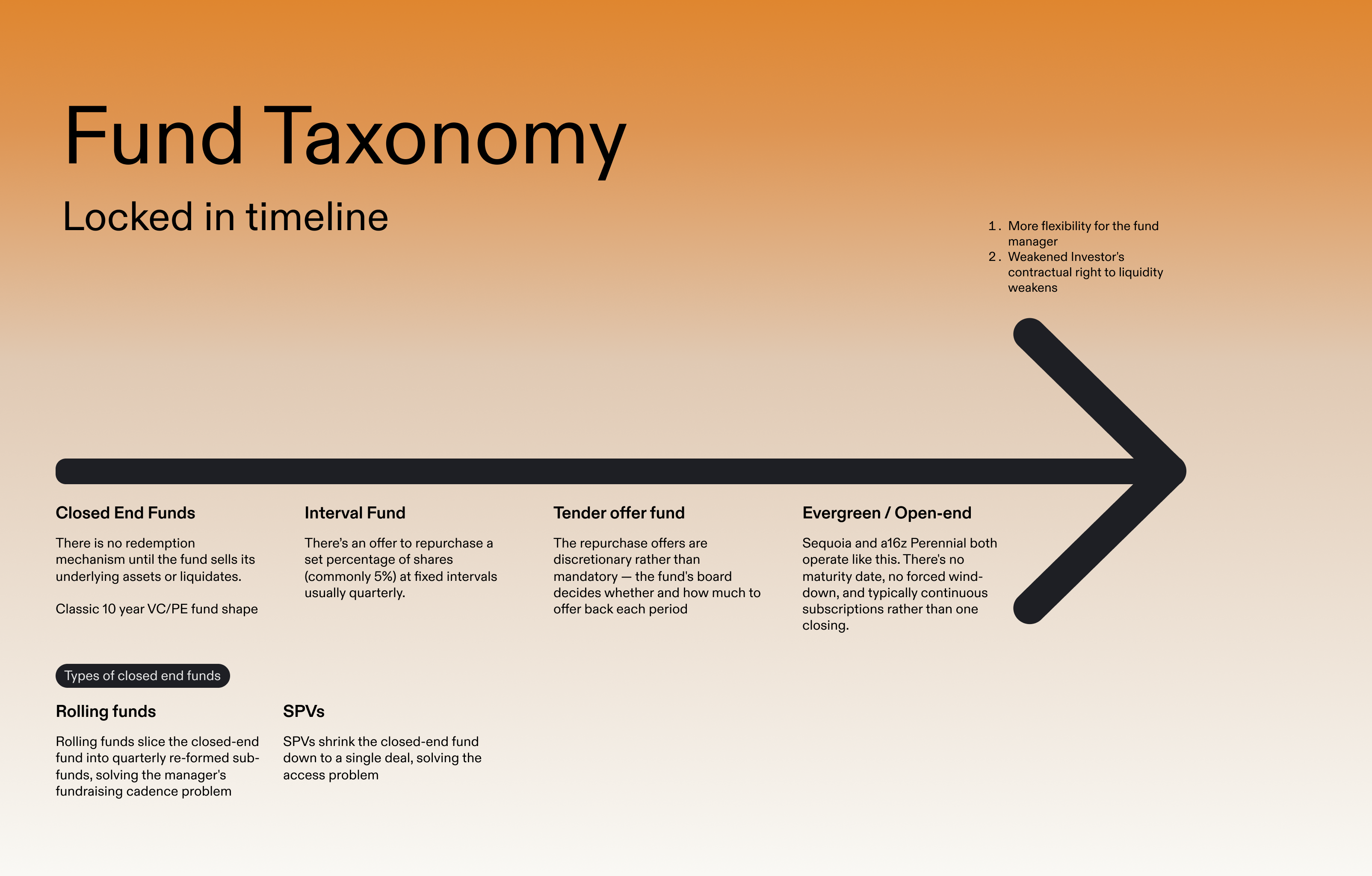
The Fund Taxonomy
There are two other types of funds existing in the gradient between closed-end funds and evergreen funds (open-end), the interval fund and the tender offer fund. As we go from left to right on the diagram, there is more flexibility for the fund manager to choose what to do with the capital, and there is a weakened contractual right for the LP.
Which brings us to the fund structures of Silicon Valley, Rolling funds and SPVs.
The Silicon Valley Classic — Rolling funds and SPVs (special purpose vehicles)
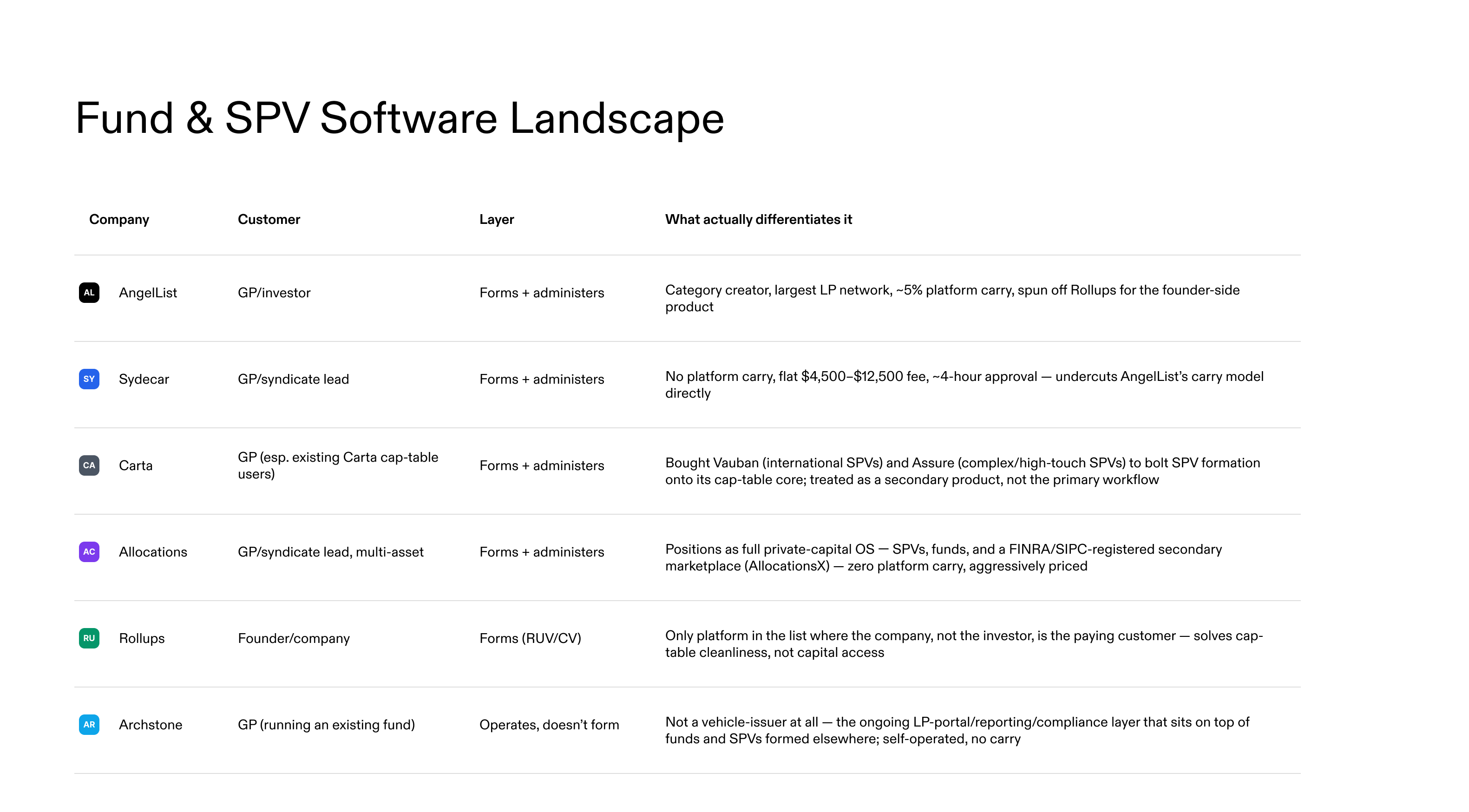
With the popularity of the evergreen fund, the plumbing, infrastructure, and user interface for these fund businesses have caught up.
Angellist built products to launch both SPVs and venture funds
Sydecar built has a product to launch SPVs
Carta has an SPV product
Allocations has an SPV product
Archstone is the latest competitor to the space, building the OS for private capital
From the founder side, since many people want to get allocation into a round, founder’s use Rollups, in order to keep other people’s money off their capitalization table. Instead of dealing with 40 individual investor lines, the founder gets one wire and one entry and rollups handle all the ongoing K-1s, and investor communications from there.
So when Kusher, Sequoia, or another venture fund does a billion dollar deal, you know now that the return will continue to compound indefinitely inside the fund. Instead of the status quo of “when do I need to sell this to return capital to my LPs", there is no timeline. It’s all compounding indefinitely. This new operating model is how the next generation of Silicon Valley companies and fund structures owns capital instead of flipping them.
Why this matters for Silicon Valley
A GP with a 10 year fund gets graded by their IRR and with specific liquidity events to make their LP whole - they put pressure on their startups to the fund’s schedule not the companies schedule.
If we remove the clock and time pressure, then the inventive becomes less about harvesting the capital at the right multiple, but instead about compounding NAV indefinitely.
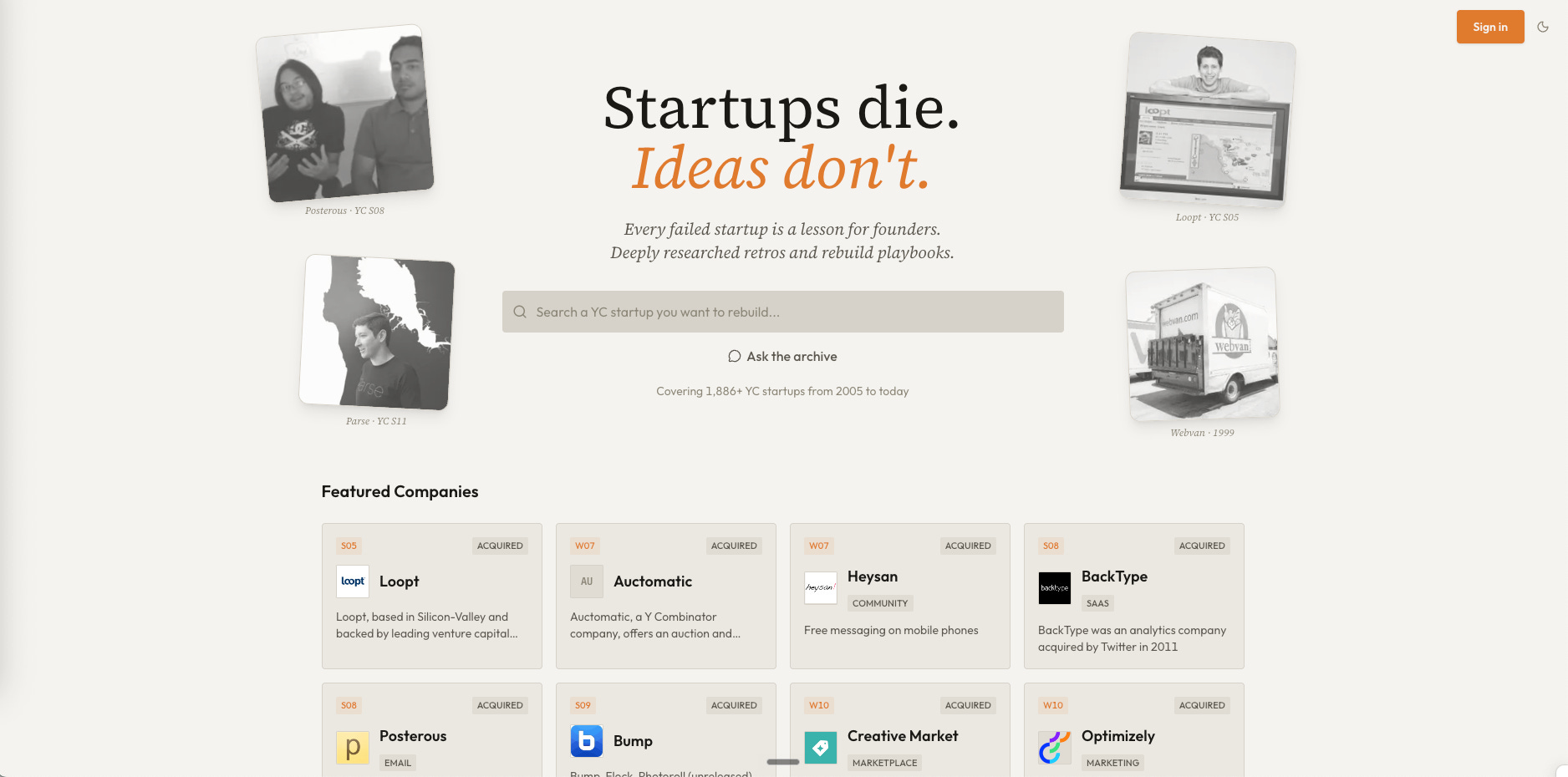
Startups.rip has 1,886+ YC startups from 2005 to today, that either were acquired or inactive. Some of these startups were solutions in search of a problem, or even outright negative unit economics + bad ideas. But it begs the question of how many of them could still be ongoing if investor multiples weren’t pushed on them?
With the new focus into hardtech, deeptech, and biotech advancements for these startups, we will see how many of these fund structures have forcing structures for investor alignment with LP return time tables, or whether there are specific liquidity events that push portfolio companies onto the GP fund return timelines.
References:
a16z’s Schedule D when filing for their Investment Adviser Registration
Sequoia’s Capital Operations, LLC, Schedule A form. It’s interesting to see the married couple dynamics with power - Examples like: Alfred Lin & Rebecca C. Lin, trustees of the Evergreen Fulfrog Trust, Colis Zhan Family Trust (Peter George Colis + Stephanie Zhan), Madison Gillette Trust, Pat Grady and Sarah Guo trustees
Alfred Lin’s Form 4 on August 6, 2026 announcing the transfer of Doordash shares